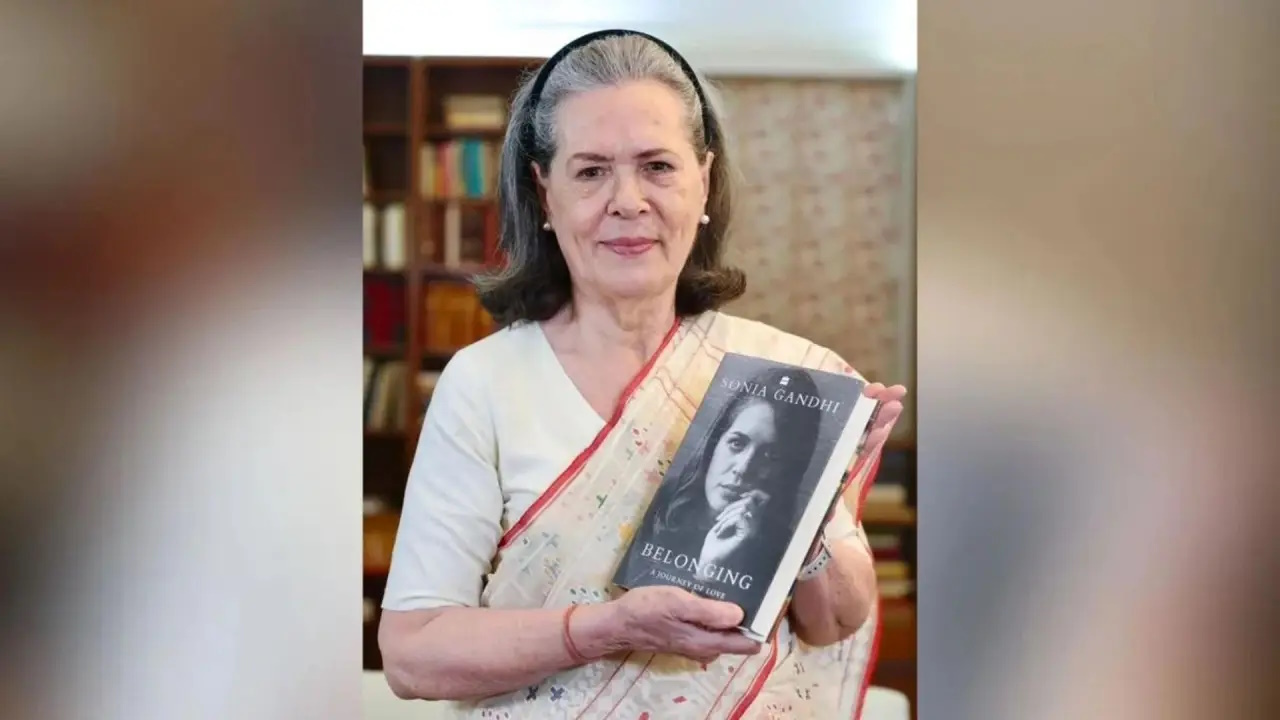
New Delhi: October 31, 1984, stands as one of the most tragic chapters in Indian political history. On that day, Indira Gandhi, then Prime Minister of India, was shot dead by her own security personnel. The memories of this assassination, which shocked not only India but the entire world, remain sharply etched even four decades later. Congress leader Sonia Gandhi heartbreakingly narrates the events of that day through the perspectives of a daughter-in-law, a mother, and a wife. Her autobiography, 'Belonging: A Journey of Love,' scheduled for release on November 10, details the final moments of Indira Gandhi’s life as well as the subsequent developments within the Nehru-Gandhi family.
The day of October 31, 1984 began as usual, but Sonia Gandhi never imagined it would turn into the most terrifying day of her life. While preparing to bathe in her own room, she heard sounds outside resembling firecrackers. At first, she could not comprehend what was happening. But soon indications began to suggest a grave calamity had taken place. Ongmu, the ayah of Rahul and Priyanka, was seen trembling as she crouched by the bathroom door, crying and pointing towards the garden. Noticing the fear and anxiety on their faces, Sonia realized that something serious must have happened. Wasting no time, she ran outside.
Upon reaching near Akbar Road, Sonia recalls witnessing an image she would never forget for life. A white Ambassador car was slowly moving, attempting to take the shot Indira Gandhi to the hospital. Sonia boarded the vehicle and sat on the floor beside her. The sight she saw shattered her: Indira Gandhi’s sari and chest were soaked in blood. Though gravely injured, her eyes remained open, displaying a look of shock. Sonia describes the expression on her mother-like figure’s face as that of disbelief. Repeatedly, she called out, “Amme…” but received no response. Indira Gandhi lay motionless. Sonia hoped for a miracle, wishing she would speak again.
Sonia remembers facing numerous hurdles while trying to swiftly get the critically injured Indira Gandhi to the hospital. Traffic congestion clogged the roads of Delhi, making the journey extremely difficult. Every minute was precious, yet the vehicle’s slow progress heightened the family’s worry.
Upon arrival at the hospital, the crisis was not yet over. The gates were closed, blocking entry. Sonia recounts these fraught moments amid efforts to save her mother figure’s life as deeply painful. Finally, Indira Gandhi was admitted and the doctors began emergency treatment. However, the grave injuries and excessive blood loss rendered her condition very critical. Hours of agonizing waiting followed for Sonia. She oscillated between hope for her survival and terror of the worst news. Watching the doctors’ faces for updates, she eventually questioned one, only to receive the most painful answer – a silent nod indicating that Indira Gandhi could not be saved.
Indira Gandhi’s death was officially announced at approximately 2 PM on October 31, 1984. The curtain fell on an era in Indian politics. For the Nehru-Gandhi family, it was an irreparable personal loss.
Returning home after the death, Sonia was met with yet another heartbreaking scene. Rahul and Priyanka were urgently brought home from school by security personnel. Both children sensed something was terribly wrong but did not know the full extent of the tragedy involving their grandmother. When Sonia arrived home, the children cried and clung to their mother, filled with questions: Where was their mother? Where was their grandmother? What had happened? Why had no one told them the truth? Answering these was another immense emotional ordeal for Sonia. Unable to control her own grief, she nevertheless had to comfort her children.
For Rahul and Priyanka, who shared a close bond with their grandmother, that day became one of the most traumatic experiences of their childhood.
At the time of the shooting, Rajiv Gandhi, Indira Gandhi’s son, was not in Delhi but attending political events in West Bengal. Sonia writes in her memoir that Rajiv heard of his mother’s critical condition through the BBC. Upon learning this, he cut short his engagements and returned to Delhi. Alongside concerns about her health, crucial discussions regarding the country’s political future began.
Rajiv Gandhi was informed that he was being asked to take oath as Prime Minister following Indira Gandhi’s assassination. Sonia describes how distressed she was upon hearing this. Her greatest fear was that Rajiv, like his mother, would become a target of the assailants. She pleaded with Rajiv not to assume the Prime Ministership, fearing for his life and the dangers the political responsibilities would bring. Rajiv’s response intensified Sonia’s anguish: “They will kill me anyway.” She reflects in her autobiography on the terrifying dread that swept through her on hearing this. Rajiv’s political path held the ominous possibility of leading him to a similar tragedy—a fear that years later would come true.
On May 21, 1991, Rajiv Gandhi was assassinated in a suicide bomb attack during an election campaign in Sriperumbudur, Tamil Nadu. The words Rajiv spoke after Indira Gandhi’s assassination were haunted by the tragedy that unfolded later.
The news of Indira Gandhi’s death sent shockwaves throughout the nation. Amid uncertainty in political leadership and governance, Rajiv Gandhi decided to assume the Prime Minister’s office. At around 6.30 PM on October 31, 1984, Rajiv Gandhi took oath as India’s Prime Minister. He was thrust into the responsibility of leading the nation while grieving the sudden loss of his mother. This was the most critical turning point in Rajiv Gandhi’s political journey. However, Sonia’s foremost concern was not her husband’s political rise but his safety.
Indira Gandhi’s assassination profoundly influenced India’s political history. The assailants Satwant Singh and Beant Singh were part of her own security detail. The assassination triggered anti-Sikh riots across the country, particularly in Delhi, leading to the killing of thousands of Sikhs. These riots became one of independent India’s darkest chapters.
Yet for Sonia Gandhi, October 31, 1984, was more than a political event — it was a day that destroyed her personal life. The morning gunshots, her mother covered in blood, the unanswered call of “Amme,” the long wait at the hospital, the doctor’s silent nod, the tearful children’s questions at home, and fears for Rajiv Gandhi’s future all remain indelibly imprinted in her memory.
October 31, 1984, recorded in history books as the day of a political assassination, remains for Sonia Gandhi a day filled with tears, fear, and the painful separation of a nation’s Prime Minister and a family’s beloved mother and guiding grandmother.
n
Original Malayalam report: Malayalam Daily News