
Goa CEO’s office reportedly sought rollback facility eight times in seven days; EROs had found 97 electors eligible, but their names did not appear in the final SIR roll
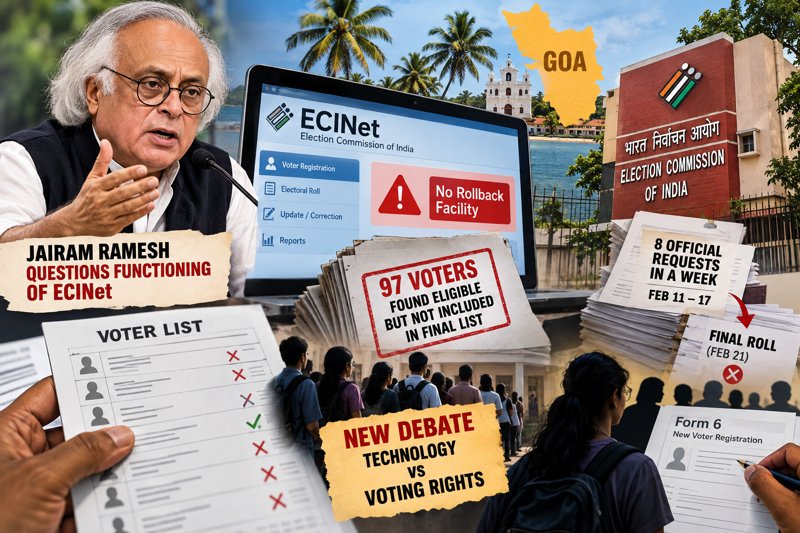 Panaji: A controversy over the Election Commission of India’s ECINet system has intensified after reports emerged that 97 voters in Goa, who were found eligible for inclusion by Electoral Registration Officers (EROs), were nevertheless left out of the final electoral roll published following the Special Intensive Revision (SIR).
Congress general secretary Jairam Ramesh cited the Goa episode to question the functioning and centralisation of ECINet, arguing that technology should not prevent statutory election officials from implementing decisions taken after verification. The Election Commission, however, has explained that the software did not have a rollback provision to reverse a deletion once the relevant Form 7 action had been processed.
According to an investigation by The Indian Express, the office of Goa Chief Electoral Officer Sanjay Goel contacted senior Election Commission officials eight times between February 11 and February 17, seeking a rollback or reversion facility in ECINet. The request concerned 97 electors whose cases had been reconsidered by EROs and Assistant EROs and who were subsequently found eligible for inclusion in the final electoral roll.
The voters had initially been flagged during the SIR process for what election authorities described as “logical discrepancies.” Following a Supreme Court-directed process, affected electors were given an opportunity to submit documents or objections and appear before election officials.
In Goa, 649 electors reportedly responded to this process. After examining their cases, EROs and AEROs concluded that 97 of them were eligible and that the earlier decisions affecting their inclusion needed to be reversed.
The Goa CEO’s office repeatedly sought the technical facility required to implement those decisions. Communications were reportedly sent between February 11 and 17 to senior Election Commission officials, with the matter described as urgent because the final electoral roll was due to be published shortly.
On February 17, Goa officials forwarded the list of the 97 electors and requested that necessary steps be taken to include them in the final SIR 2026 electoral roll.
The following day, Deputy Election Commissioner Sanjay Kumar, who handles electoral-roll matters at the Commission, reportedly told the ECI’s IT division that EROs and AEROs had statutory powers to take corrective action and that the IT system should not prevent implementation of directions arising from the Supreme Court process.
Nevertheless, when Goa’s final electoral roll was published on February 21, the 97 names were not included. The Indian Express reported that its subsequent verification found that the names remained absent as of September 20.
The Election Commission has since provided an explanation for the technical problem. According to its response reported by India Today, ECINet did not contain a rollback mechanism allowing EROs to reverse a deletion after the Form 7 process had been activated.
The Commission said EROs have the authority within the electoral-roll system to add or delete names in accordance with prescribed procedures. However, once a deletion had been processed through Form 7, the software did not provide a mechanism to reverse that particular action.
The explanation has nevertheless raised questions about why the repeated requests from Goa officials for a technical solution were not implemented before publication of the final roll.
Citing the episode, Jairam Ramesh alleged that excessive centralisation of ECINet was restricting the ability of EROs and other field-level officials to exercise their statutory responsibilities.
His criticism also comes against the backdrop of reports that Election Commissioners Sukhbir Singh Sandhu and Vivek Joshi had raised objections on several occasions concerning aspects of the SIR process, including the centralisation of ECINet and the role available to state and field-level election officials.
The Goa episode has consequently brought a broader administrative question into focus: what should happen when a statutory election official determines that a voter is eligible, but the software being used to manage the electoral roll does not provide the functionality needed to implement that decision?
Another issue concerns the procedure available to voters whose names remain absent. Some of the affected electors were reportedly advised to apply through Form 6, which is ordinarily used for new voter registration.
The Election Commission’s official voter portal currently identifies Form 6 as the application for new voter registration for eligible citizens. Critics argue that requiring an already-verified elector to begin a fresh registration process could impose an additional procedural burden.
The political implications of the Goa case remain contested. Congress and other Opposition parties have cited it as evidence of problems with the SIR and the centralised electoral-roll system, while the Election Commission has maintained that electoral-roll revision is intended to maintain accurate rolls and address issues such as duplicate entries, deceased electors and changes in residence.
The immediate controversy, however, centres on a specific and documented issue: 97 electors were found eligible by Goa election officials, repeated requests were made for the technical facility needed to reverse their earlier exclusion, but their names did not appear in the final roll published on February 21.
The episode has therefore widened the debate beyond Goa, raising questions about how ECINet should be designed so that technological controls support — rather than obstruct — lawful decisions taken by statutory electoral authorities.


