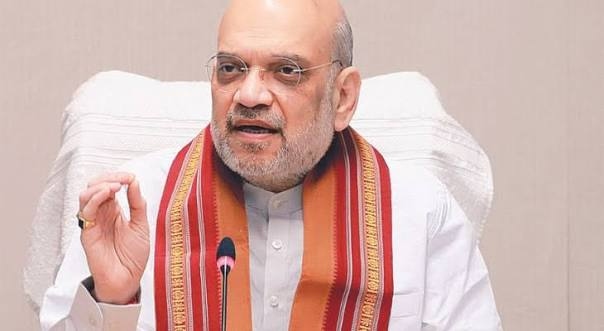
 New Delhi: A major political controversy has erupted over Union Home Minister Amit Shah’s remarks concerning illegal immigration and infiltration into India, particularly his claim that there are approximately 30 million (three crore) Bangladeshi infiltrators in the country.
The statement has triggered a heated exchange of accusations and counteraccusations between the ruling Bharatiya Janata Party (BJP) and opposition parties.
While BJP leaders have accused opposition parties of protecting illegal immigrants for political gains, senior leaders of the Congress and Samajwadi Party have questioned the Home Minister’s claim and demanded concrete evidence.
Opposition leaders have also asked why the central government has failed to take effective legal action if such a large number of illegal immigrants are living in the country.
Senior Congress leader Udit Raj has openly challenged Union Home Minister Amit Shah to release credible documentary evidence supporting his claim that approximately 30 million Bangladeshi infiltrators are residing in India.
Questioning the government’s assertions, Udit Raj said that if such a large number of illegal immigrants are present in the country, the authorities should possess reliable records establishing their identities and immigration status.
He demanded that the central government compile an official digital database of the alleged illegal immigrants and make the relevant information publicly available, subject to applicable legal and privacy safeguards.
The Congress leader also questioned the government’s performance in addressing illegal immigration, pointing out that the BJP-led central government has been in power for approximately twelve and a half years.
He asked why the government had apparently failed to identify, investigate, and initiate appropriate legal proceedings against the alleged infiltrators during this period.
Udit Raj further questioned the credibility of the Home Minister’s claim, arguing that such a serious allegation must be supported by verifiable government records rather than political statements.
Samajwadi Party MP Awadhesh Prasad also joined the controversy, strongly criticizing the Home Minister’s remarks and questioning the basis on which individuals are being identified as infiltrators.
Prasad suggested that the Home Minister or the administrative authorities might not have sufficient factual information to distinguish between illegal immigrants and legitimate Indian citizens.
Referring to India’s history and the sacrifices made during the freedom struggle, he emphasized that countless families have lived in the country for generations and contributed to its independence and development.
He noted that the ancestors of many Indian citizens had sacrificed their lives for the nation and that generations of families were deeply rooted in Indian soil.
Against this historical background, Prasad argued that labeling individuals or communities as infiltrators without substantial evidence would be inappropriate and potentially harmful.
He stressed that government authorities must carefully examine historical records, citizenship documents, and ground realities before making sweeping allegations about the presence of illegal immigrants.
Responding to criticism from opposition parties, BJP Jharkhand spokesperson Pratul Shah Deo strongly defended Union Home Minister Amit Shah’s statement and accused previous governments of failing to prevent illegal immigration.
He alleged that large-scale infiltration from Bangladesh had significantly altered the demographic composition of several border regions and tribal-dominated areas of Jharkhand.
Citing historical census figures, the BJP spokesperson claimed that the proportion of the Santhal tribal population in the areas he referenced had declined from approximately 44 percent in 1951 to around 28 percent in 2011.
He further claimed that the Muslim population in those areas had increased from approximately 9 percent to 23 percent during the same period.
According to Shah Deo, these demographic changes raised serious concerns about illegal immigration and its potential impact on indigenous tribal communities.
However, the demographic figures cited by the BJP spokesperson do not, by themselves, establish that illegal immigration caused the reported population changes.
Pratul Shah Deo also accused previous Congress governments and leaders of the Jharkhand Mukti Morcha (JMM) of encouraging illegal immigration for electoral and political advantages.
He alleged that political parties had deliberately overlooked unauthorized migration to strengthen their electoral support bases.
The BJP spokesperson further claimed that certain political leaders and local networks had facilitated the acquisition of fraudulent identity documents by illegal immigrants, enabling them to access benefits and establish themselves in the region.
He accused opposition parties of prioritizing vote-bank politics over national security and the interests of indigenous communities.
These allegations, however, remain political claims unless supported by independently verifiable evidence and official investigations.
The controversy has brought the politically sensitive issues of illegal immigration, citizenship verification, demographic changes, and national security back into the spotlight.
While the BJP maintains that illegal immigration poses serious challenges to national security and the demographic balance of certain regions, opposition parties insist that the government must substantiate its claims with credible evidence and transparent official records.
The central question raised by Congress and other opposition leaders is whether the government possesses reliable data supporting the claim that approximately 30 million Bangladeshi infiltrators are living in India.
The dispute is likely to intensify as political parties continue to challenge one another over immigration enforcement, citizenship documentation, and the government’s responsibility to address unauthorized migration through established legal procedures.