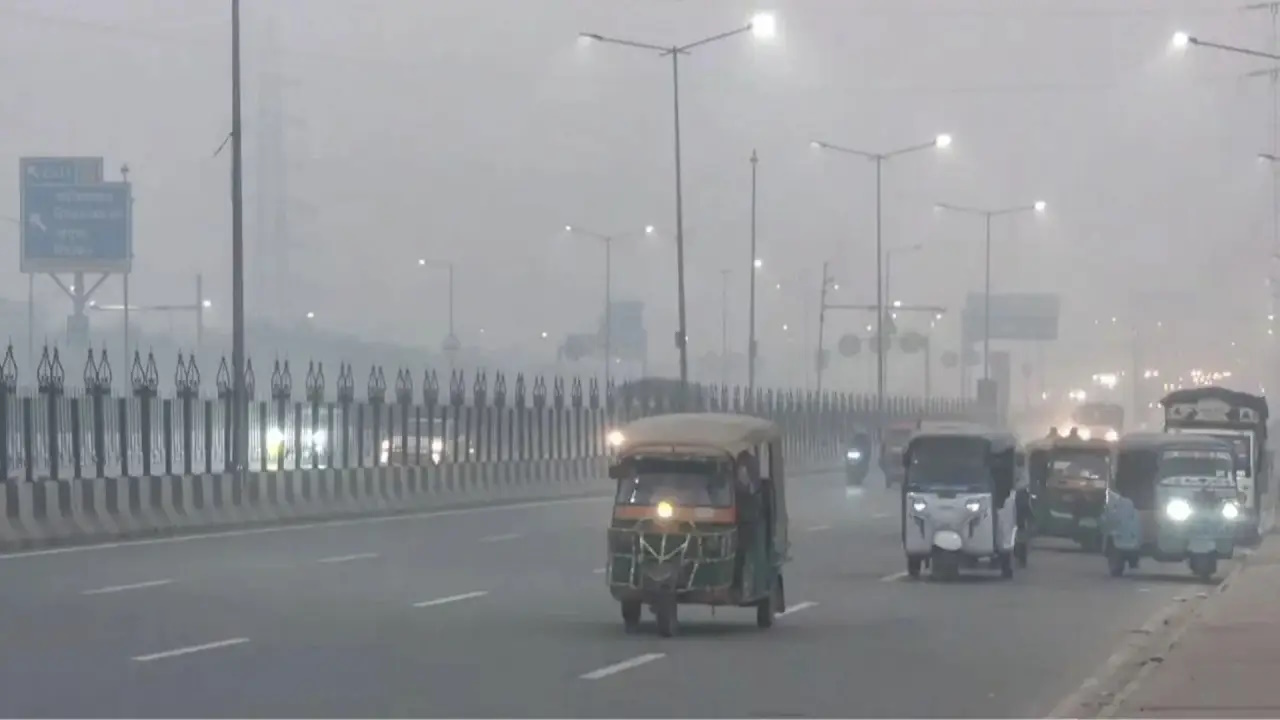
New Delhi: The Supreme Court has strongly criticized the authorities concerned as air pollution in the national capital Delhi and its adjoining areas surges to hazardous levels. The Court questioned the lapses in pollution control measures when the Air Quality Index (AQI) in the Delhi-National Capital Region (NCR) approached 400. Urging the authorities not to confine themselves merely to issuing statements on a problem gravely affecting public health and daily life, the Court demanded effective and concrete action. Chief Justice Suryakant’s sarcastic remark, “I hope all of you are enjoying the weather in Delhi,” underscored the gravity of the pollution issue and revealed the Court’s dissatisfaction with the administration’s functioning.
A three-judge bench consisting of Chief Justice Suryakant, Justice Joymalya Bagchi, and Justice V. Mohan heard the matter concerning the alarming air pollution in Delhi-NCR. The Court expressed concern that although multiple government departments and agencies frequently issue advisories and explanations on air pollution control, these efforts have not translated into tangible improvements in the lives of ordinary citizens. The bench emphasized that anti-pollution measures should not remain confined to paper but must be practically enforced.
Notably, senior advocate Aparajit Singh, appearing as amicus curiae, highlighted the severity of Delhi’s air pollution by stating in Court that breathing the polluted air in Delhi-NCR can have health effects equivalent to smoking 30 cigarettes a day. This analogy was intended to illustrate the seriousness of air pollution, but the Court clarified that it does not imply the health effects of cigarette smoking and atmospheric pollution are precisely the same. The Court explained that the high concentration of microscopic particulate matter—PM 2.5 and PM 10—in the air can cause respiratory illnesses and cardiovascular problems, and thus the situation demands utmost seriousness.
Aparajit Singh also brought to the Court’s attention that pollution adversely affects people’s physical health as well as their normal life, including communication and social interaction. It was pointed out that on November 5, agricultural waste burning contributed 14 percent to Delhi’s air pollution. This highlighted the issue of stubble burning and the measures needed to control it became a focus of detailed discussion in Court. Stubble and other agricultural residues left after harvest in states like Punjab and Haryana significantly contribute to seasonal spikes in Delhi’s air pollution. The Supreme Court urged the authorities to adopt more efficient interventions to curb such practices.
The bench acknowledged practical difficulties faced by farmers. Aparajit Singh explained that although machinery to remove and process agricultural waste is available, the fuel cost to operate them imposes an additional financial burden on farmers. It was discussed that merely distributing machinery does not solve the problem; adequate financial and technical support must also be ensured. Justice Joymalya Bagchi reminded the bench of a prior suggestion to purchase stubble from farmers at a predetermined price. This raised the prospect of exploring the use of agricultural waste as an economically valuable resource rather than discarding it as refuse.
Chief Justice Suryakant highlighted the fact that small and marginal farmers cannot afford to buy expensive agricultural machinery. Therefore, the Court recommended making such machinery available to Gram Panchayats to provide shared access to farmers, enabling them to remove and process crop residue without incurring prohibitive personal expenses. The bench further directed that farmers should be made aware of the environmental and health benefits of avoiding stubble burning. Emphasizing a holistic approach, the Court stressed the need to pair awareness campaigns and practical support with penalty enforcement.
The Court pointed out that agricultural waste burning is not the sole cause of Delhi’s pollution; vehicular emissions are also a major contributor, particularly from vehicles used by affluent sections. Chief Justice Suryakant raised pointed questions about pollution generated by vehicles of the wealthy and expressed that it is inappropriate to place the entire responsibility of pollution on farmers and economically disadvantaged groups. The Court observed that in metropolitan cities like Delhi, the increasing number of vehicles, traffic congestion, and fossil fuel consumption contribute significantly to air pollution. Therefore, effective implementation of pollution controls and regulatory mechanisms targeting vehicular emissions is imperative.
The Court’s observations collectively emphasized the necessity for equal scrutiny of all pollution-causing sectors and ensuring that those responsible for greater pollution bear proportionate accountability. The judiciary also criticized the prevailing approach of constantly introducing new regulations and bans as a measure to control air pollution, remarking that mere announcements and orders do not provide lasting solutions. The Court noted that increasing the number of orders raises the risk of violations. Alongside stricter laws, the need for adequate infrastructure and public cooperation for enforcement was highlighted.
The Court reminded authorities to respect traditional customs and social lifestyles during festivals, emphasizing the importance of balancing environmental protection with cultural practices. One of the Court’s most significant remarks was that the responsibility for air pollution should not be placed solely on marginalised economically weaker sections. Restrictions linked to pollution controls often create livelihood challenges for daily wage laborers, roadside vendors, small traders, and construction workers. Festivals like Diwali represent crucial income periods for many families dependent on seasonal and temporary employment. The Court urged consideration of such socio-economic realities when imposing regulations.
Rather than limiting restrictions to vulnerable groups, the bench insisted that the sectors and individuals who contribute most substantially to pollution must be held accountable. Air pollution in Delhi-NCR remains a recurrent, serious public health crisis every year. The onset of winter diminishes atmospheric circulation, compounding pollution from vehicle exhaust, construction dust, industrial emissions, and crop residue burning. An AQI nearing 400 poses a severe threat to public health, especially to children, the elderly, pregnant women, and those with respiratory or cardiac conditions.
Under these circumstances, coordination among government departments and identification of pollution sources for targeted action are imperative. A comprehensive, multifaceted approach is required, involving support systems for farmers, vehicular pollution control, enhancement of public transport, and industrial pollution regulation. The Supreme Court’s pointed criticism sends a resounding message that beyond administrative announcements and explanations, the authorities must create conditions where citizens can breathe clean air.
n
Original Malayalam report: Malayalam Daily News