
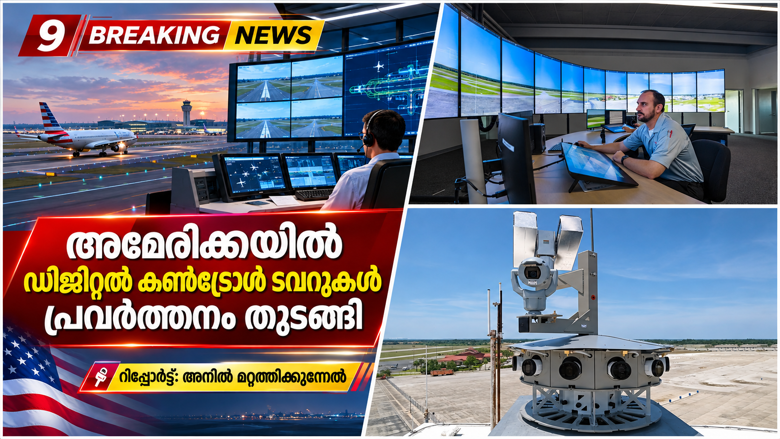
Washington: Marking a revolutionary change in the air traffic control system in the United States, the nation’s first digital air traffic control towers have commenced operations. The U.S. has implemented a new technology that replaces the surveillance systems of traditional control towers with advanced cameras and digital screens. According to an official announcement released by the Federal Aviation Administration (FAA) on November 6, 2026, the new system is operational at Barto Executive Airport in Florida and Kenai Municipal Airport in Alaska.
In conventional air traffic control towers, officers observe aircraft movements directly from tall buildings. However, in the new digital towers, high-resolution cameras installed around the airport capture visual data that is displayed on large screens. This setup provides control officers with 360-degree views of runways, taxiways used by aircraft, and the airspace surrounding the airport. The system allows for clearer monitoring of aircraft movements and provides the information necessary to make safe decisions.
This system does not eliminate human air traffic controllers; the responsibility of managing air traffic remains with the officers. Digital towers serve as technical aids, enhancing the safety and efficiency of their operations. FAA Administrator Brian Bedford stated that this new technology will be a crucial support for aviation safety in the U.S. He added that air traffic controllers will continue to perform the critical task of safely separating and managing aircraft, and the government will provide them with improved tools.
Following the success of the initial phase, the FAA plans to expand the digital tower system to five additional airports. These include Winter Haven Regional Airport and Venice Municipal Airport in Florida, Montgomery County Airpark in Maryland, Johnston Regional Airport in North Carolina, and Durango–La Plata County Airport in Colorado. The technological system chosen by the FAA for this initiative is provided by Austria-based company Frequentis.
The technology received the necessary certifications following years of testing at the William J. Hughes Technical Center in New Jersey and other locations. This development is part of a broad project aimed at modernizing the aging air traffic control infrastructure in the U.S., replacing decades-old computers and communication equipment with more reliable digital systems.
Alongside the $12.5 billion air traffic control modernization project approved by Congress in 2025, the federal government is considering further investments. The digital system had already begun operations at Bartow Airport, Florida, in September 2026. On November 6, the FAA officially announced the operational status of the first systems in Florida and Alaska nationwide.
Authorities expect this technology to play a decisive role in improving airport security and operational efficiency. Digital towers are poised to become a significant milestone in the future of air traffic management in the United States.
n
Original Malayalam report: Malayalam Daily News