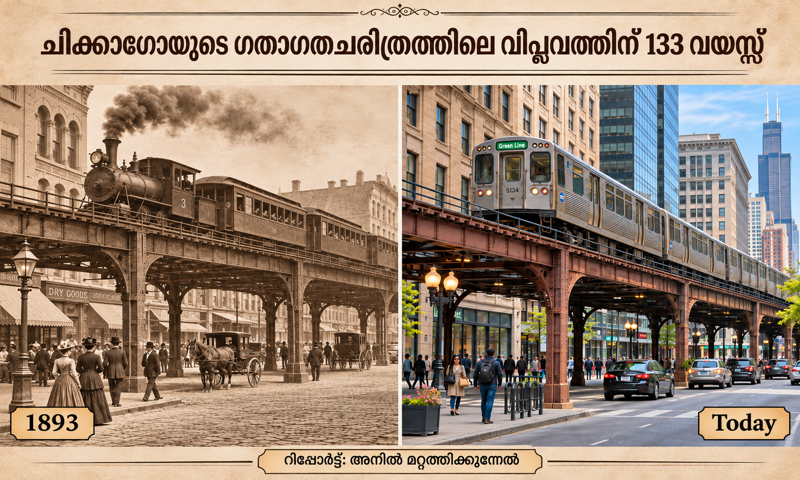
Chicago, November 6, 2026: It has been 133 years today since the Lake Street Elevated Railroad service began, marking a revolutionary change in the transportation history of the city of Chicago. Regular public service on this historic railway commenced on November 6, 1893. This route, which today continues as the Green Line of Chicago's proud 'L' train system, made significant contributions to the city's growth and development towards the end of the nineteenth century.
Prior to 1893, residents of Chicago primarily traveled on foot, by horse-drawn carriages, and streetcars. Crowded streets and traffic congestion made travel within the city difficult. It was under these circumstances that the elevated iron track system was introduced, running trains above the streets. Unlike today's electric trains, the earliest trains operated with small steam engines burning coal. These engines pulled passenger cars along the elevated tracks.
Although the official inauguration ceremony was held on November 4, 1893, regular passenger service started on November 6. The initial service stretched from the Madison–Market area near what is now the West Loop to California Avenue. Historical records indicate that over 50,000 passengers used the new transportation system on its first day of operation.
The elevated trains dramatically reduced travel time for city residents. By enabling rapid access to commercial establishments and workplaces, the railway facilitated the development of the city’s western regions. In 1896, the Lake Street Railroad transitioned from steam-powered engines to electric trains, resulting in reduced coal smoke and noise from the engines.
In the decades that followed, the route was expanded and integrated into Chicago’s primary public transportation network. Today, the historic line operates as part of the Chicago Transit Authority’s (CTA) Green Line service. Despite modern trains and renovated stations, the transportation legacy that began in 1893 continues today.
Chicago’s ‘L’ train system holds a decisive place in the history of urban transit in the United States. For 133 years, it has stood as an active monument linking the city’s past and present.
n
Original Malayalam report: Malayalam Daily News